
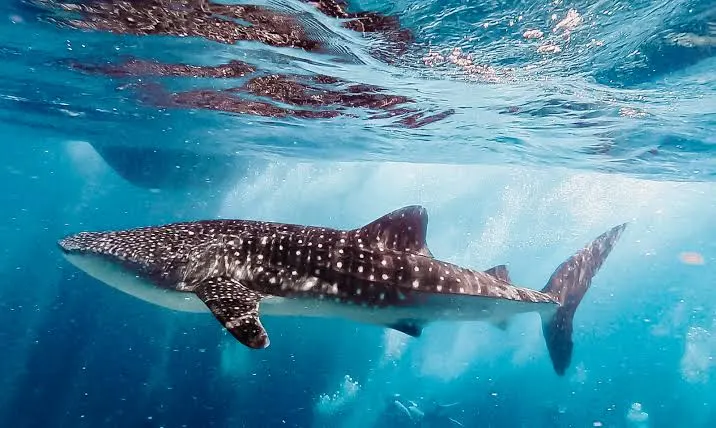
Swimming beside the largest fish in the sea is one of the most unforgettable things you can do in the Maldives. The best place to try is South Ari Atoll, and the best base for it is Dhigurah, a long, quiet local island right on the edge of the South Ari Marine Protected Area. This guide explains how to see whale sharks in the Maldives, what a trip involves and how to make sure your encounter is safe for you and for the shark.
About whale sharks
Whale sharks are sharks, not whales, and they are completely harmless to people. They feed by filtering plankton and small fish from the water through their huge mouths. Adults can grow to more than 12 metres long, though the whale sharks seen in South Ari are mostly juveniles, often between 4 and 8 metres. Each one has a unique pattern of white spots, which researchers use like a fingerprint to identify individuals.
Whale sharks are listed as endangered worldwide. In the Maldives, they are protected, and the South Ari Marine Protected Area was created to safeguard the area where they are most often seen.
Why South Ari?
The southern edge of Ari Atoll, stretching along the outer reef near islands such as Dhigurah and Dhidhdhoofinolhu, is one of the few places in the world where whale sharks are seen year-round. Researchers believe that many of the sharks here are young males that return to the area again and again. Because they often swim near the surface, they can be seen by snorkellers as well as divers.
Why stay on Dhigurah?
Dhigurah sits right beside the protected area. Trips leave from the island harbour, and boats can reach whale shark waters in a short time. That means more time searching and swimming, and less time on the boat. You also get to enjoy Dhigurah itself: a long, green island with a huge sandbank and some of the prettiest beaches on any local island.
If you are deciding between islands, our comparison Maafushi, Thulusdhoo or Dhigurah? explains what makes Dhigurah special.
What a whale shark trip is like
- Briefing: your guide explains the rules, the plan and what to do when a shark is spotted.
- Searching: the boat cruises slowly along the outer reef while the crew watches for the shadow of a shark near the surface. This can take minutes or hours.
- The encounter: when a shark is seen, the guide asks you to slip quietly into the water and swim to the side of the shark, following instructions.
- Swimming alongside: whale sharks move slowly but steadily. You swim beside them for as long as you comfortably can.
- Back on board: boats often combine the trip with a reef snorkel, a sandbank stop or manta search.
When to go
Whale sharks can be seen in South Ari throughout the year. Sightings are never guaranteed, because these are wild animals, but local operators often have good success. Sea conditions vary with the monsoon. From around December to April, the northeast monsoon usually brings calmer seas and clearer water. From around May to November, the southwest monsoon can bring wind and waves, but trips still run on most days.
Read when to go: month by month for a fuller picture.
Swimming responsibly
The rules for swimming with whale sharks exist to protect them. Repeated disturbance can change their behaviour, and boat strikes injure many sharks. Please follow the code of conduct used in the Maldives:
- Keep your distance: stay at least 3 metres from the head and body and 4 metres from the tail.
- Never touch: touching can damage the protective mucus on their skin and stress the shark.
- Don't chase or block: swim to the side, never in front of the shark's path.
- No flash photography: use natural light only.
- Limit the group: no more than around ten swimmers with one shark.
- Enter quietly: slip into the water rather than jumping or splashing.
- No scuba near snorkellers: follow your guide's instructions on keeping groups separate.
Choose operators who follow these rules, and don't be afraid to speak up if a boat behaves badly. For more on travelling gently, read preserving our islands: how your choices make a difference.
Choosing a trip
- Ask about group size: smaller groups give better encounters.
- Ask about the code of conduct: good operators brief you before you enter the water.
- Look for local operators: many Dhigurah guesthouses run their own trips, so your money stays in the community.
- Check what's included: snorkel gear, drinks, a reef stop and how long you will search.
- Be flexible: if the sea is rough, a good operator may suggest another day.
Can you see whale sharks while diving?
Yes. Dive centres in South Ari sometimes encounter whale sharks on reef dives along the outer edge of the atoll. However, because the sharks are usually near the surface, snorkelling encounters are more common. If you are new to diving, read your first dive in the Maldives.
Other marine life nearby
South Ari is rich in marine life beyond whale sharks:
- Manta rays: seen at cleaning stations and feeding areas in Ari Atoll, depending on the season. See where to snorkel with mantas.
- Turtles: green and hawksbill turtles are common on reefs around Dhigurah.
- Reef sharks and rays: blacktip reef sharks and stingrays often cruise the shallows.
- Dolphins: spinner dolphins are seen on boat trips.
Photography tips
- Use a wide-angle lens or action camera. Whale sharks are big, and you need to be at a respectful distance.
- Shoot from slightly in front and to the side, without blocking the shark.
- Keep your fins below the surface to avoid splashing.
- Don't forget to put the camera down and simply watch.
Life on Dhigurah between trips
Whale shark trips usually take half a day, which leaves plenty of time to enjoy the island. Dhigurah is about three kilometres long, with a shaded path running through its centre and beaches along both sides. Rent a bicycle and ride to the far end, where the island narrows into a long sandbank. At low tide you can walk out along the sand with turquoise water on both sides, one of the most beautiful walks in the Maldives.
The village sits at one end of the island, with a school, a mosque, small shops and a harbour where fishing boats come and go. Children play football in the evenings, and families sit outside on joali chairs to chat as the sun goes down. Dress modestly in the village, and keep swimwear for the bikini beach. Our guide to bikini beaches and island rules explains what's expected.
Many guesthouses on Dhigurah offer full board, with fresh fish, curries and Maldivian breakfasts. It is a good choice here, as there are fewer restaurants than on busier islands.
Getting to Dhigurah
Most visitors take a shared speedboat from Velana International Airport, which usually takes around one to one and a half hours depending on the sea and the route. Another option is a domestic flight to Maamigili, followed by a short boat ride. Ask your guesthouse to arrange the transfer and match it to your flight. Read speedboat, ferry or seaplane to compare the options.
How many trips should you book?
If seeing a whale shark is the main reason for your visit, plan at least three or four nights on Dhigurah and consider booking more than one trip. Sightings are never guaranteed, and weather can cancel a day. Some operators offer a discount or a second trip if you don't see a shark the first time. Ask when you book.
Keep your expectations realistic and your plans flexible. Even a day without a whale shark usually brings turtles, reef fish and a beautiful stretch of ocean.
What to bring
- Mask, snorkel and fins (rental is usually available).
- Rash vest or long-sleeved swim top for sun protection.
- Reef-safe sunscreen.
- Water, a hat and a towel.
- Seasickness tablets if the sea is choppy.
Above all, remember that every whale shark encounter is a privilege. These animals travel huge distances through the ocean, and the few minutes you spend beside one are minutes on their terms. Swim gently, give them space and let them go on their way.
The short version
South Ari is one of the best places on the planet to swim with whale sharks, and Dhigurah puts you right next to it. Book with a responsible local operator, follow the code of conduct, be patient while the crew searches and enjoy one of the greatest wildlife encounters you will ever have. Then come back to Dhigurah's sandbank for sunset and let it all sink in.
Questions
When can you see whale sharks in the Maldives?
Whale sharks can be seen in South Ari Atoll throughout the year. Sightings are never guaranteed, but the area is known for resident juveniles that are seen regularly.
How close can you swim to a whale shark?
Keep at least 3 metres from the body and 4 metres from the tail. Never touch, chase or block the shark's path.
Do I need to dive to see whale sharks?
No. Whale sharks usually swim near the surface, so most encounters happen while snorkelling.
Is Dhigurah a good base for whale shark trips?
Yes. Dhigurah sits right next to the South Ari Marine Protected Area, so trips are short and you have more time in the water.
Keep reading
Islands
Malé to Maafushi: Ferry or Speedboat?
Public ferry or speedboat? Here's how to get from Malé and Velana Airport to Maafushi, with journey times, rough costs and tips that make the trip easy.
Islands
Addu City Guide
Discover Hithadhoo and the connected islands of Addu City. From British colonial history and the longest road in the Maldives to the integrated RTL bus and ferry network, here is your ultimate guide to the "Southern Capital."
Islands
Thinadhoo City: The Resilient Heart of the South
Discover the rich history, vibrant economy, and southern charm of Thinadhoo City. Learn how to navigate the Huvadhu Atoll using the RTL Zone 5 network.